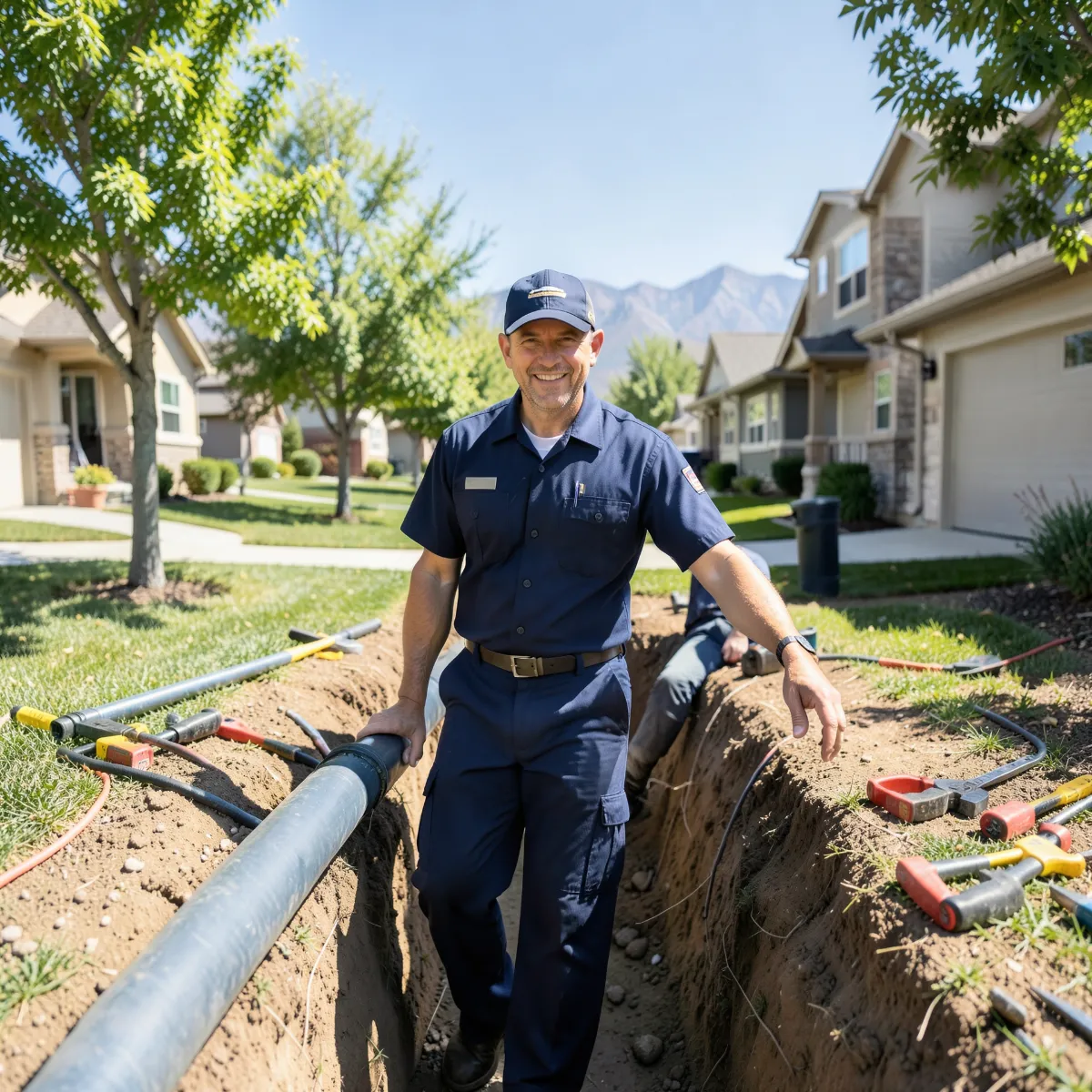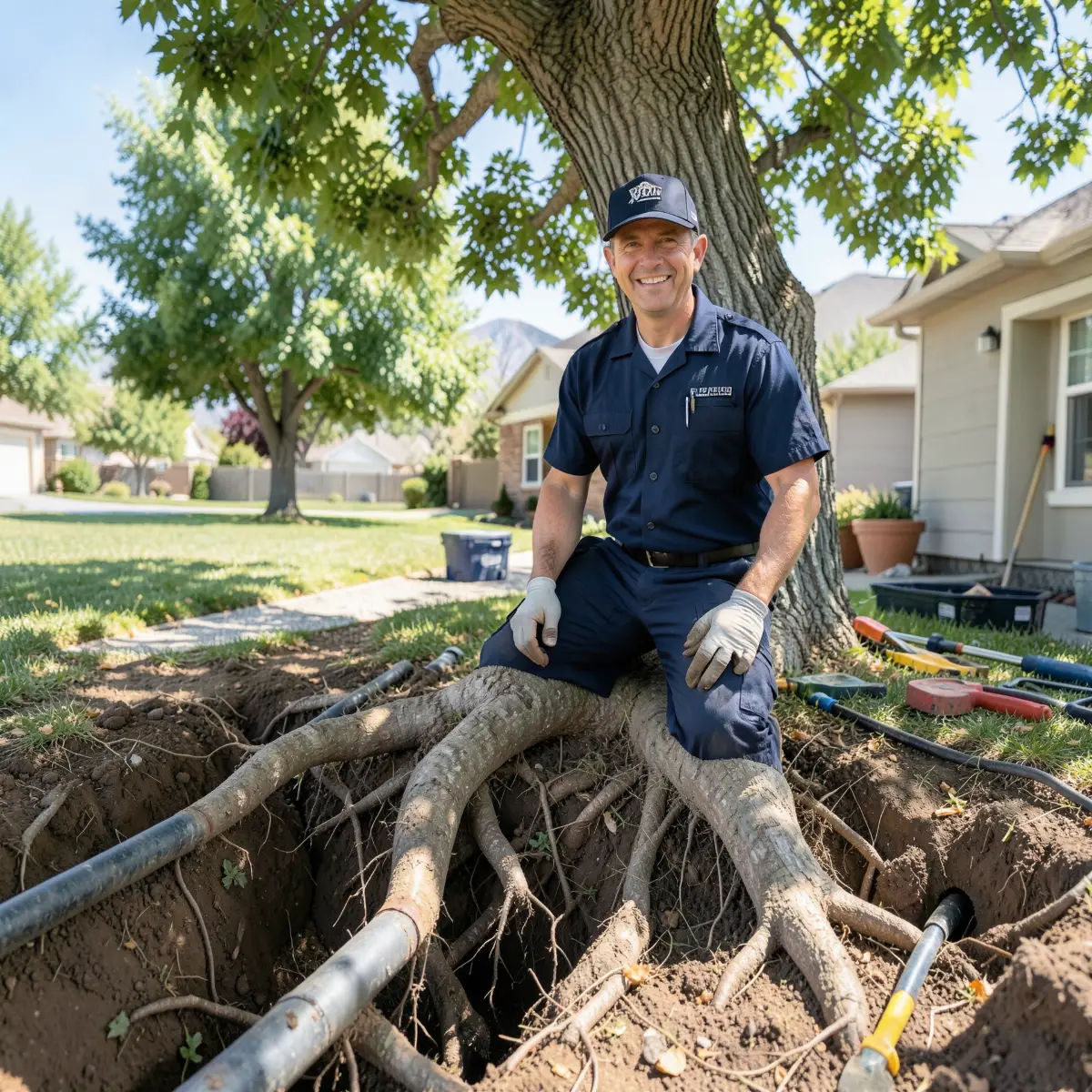
There is a reason experienced plumbers in Arvada can often predict the sewer call before they even pull in the driveway. A pre-1960 bungalow near Olde Town with a towering silver maple in the front yard — the sewer lateral under that yard is almost certainly fighting a losing battle with roots and aging clay pipe. The neighborhood tells the story.
This is not about fear. Older Arvada homes are excellent homes. But their sewer systems were built with materials and methods that made sense in 1955 and have been degrading since. Understanding the specifics helps homeowners make informed decisions — and avoid spending money on fixes that only delay the inevitable.
Clay tile pipe: what it is and why it fails
From roughly 1900 through the 1960s, clay tile was the dominant material for sewer laterals — the pipe running from the house to the city main. It was fired ceramic, durable against soil pressure, and resistant to chemical degradation. What it was not: flexible or tightly jointed.
Clay tile sections are typically 2–4 feet long and joined with a bell-and-spigot connection held by mortar or a rubber gasket. Over decades, soil movement — Arvada sits on Front Range clay soils that expand and contract significantly with moisture — shifts those joints. A shifted joint is a gap, and a gap is an invitation for tree roots.
Beyond joint failure, clay tile becomes brittle with age. Sections develop longitudinal cracks from soil load. In severely degraded lines, the pipe can belly — sag between support points — creating low spots where waste accumulates instead of flowing to the main. A bellied pipe cannot be cleaned; it needs repair or replacement.
Orangeburg pipe: the material that should not have lasted this long
During and after World War II, metal was scarce and building continued. Orangeburg pipe — a layered composite of tar and compressed cellulose — was used as a cheap substitute for clay in many residential sewer laterals between roughly 1945 and 1972. The product was never intended to last more than 50 years. It is now well past that in every Arvada home where it was installed.
Orangeburg absorbs moisture over time and deforms. Round pipe becomes oval, then D-shaped, then collapses. Video inspections of Orangeburg lines routinely reveal pipe that has deformed to 40–60% of its original bore before any blockage history. A deformed Orangeburg line cannot be hydro-jetted safely; the pressure deforms it further. It needs to be replaced.
In Olde Town and the surrounding neighborhoods built in the postwar years, Orangeburg is more common than many homeowners realize. If your home was built between 1945 and 1970 and you have never had a camera inspection, you may not know what your lateral is made of.
Clay soil and root intrusion: the compounding problem
Arvada's Front Range clay soils expand when wet and contract when dry. That seasonal movement — year after year — works pipe joints like a lever, eventually opening hairline gaps. Meanwhile, the moisture inside the sewer pipe is exactly what tree roots seek. Roots find the smallest gap, enter the pipe, and grow into the nutrient-rich wastewater environment inside.
Mature cottonwoods, silver maples, and elm trees — which Arvada has in abundance in its older neighborhoods — send roots 20–40 feet from the trunk. A tree in the parkway strip between the sidewalk and street can intrude on a lateral running under the front yard without the tree being anywhere near the cleanout. Root intrusion rarely announces itself until enough root mass has built up to cause a backup.
Sewer line repair options for root intrusion depend on the pipe condition. In healthy clay with isolated joint intrusion, trenchless sewer repair — specifically CIPP lining — can seal joints and restore the pipe interior without excavation. In deformed Orangeburg or severely cracked clay, replacement is the only lasting answer.
Trenchless vs. traditional replacement: the modern options
Homeowners in older Arvada homes often assume sewer repair means a torn-up yard, damaged driveway, and weeks of disruption. That was true for traditional open-cut excavation, and it is still the right approach for some situations. But trenchless technology has changed the calculus for many older-home sewer repairs.
CIPP (cured-in-place pipe) lining inserts a resin-saturated liner into the existing pipe through a small access point, inflates it against the pipe wall, and cures it in place. The result is a smooth, jointless new pipe inside the old one. It is ideal for clay tile with root intrusion and joint gaps, provided the host pipe has not collapsed. Pipe bursting — another trenchless method — replaces the old pipe entirely by fracturing it outward as a new HDPE pipe is pulled through. This works in heavily deteriorated lines and can upsize the replacement pipe.
Call (207) 419-2600 to discuss which approach fits your line's actual condition. The camera tells you; the camera is always the starting point.
Key takeaways
- Clay tile and Orangeburg pipe — common in pre-1970 Arvada homes — degrade over time and fail in predictable ways.
- Arvada's clay-heavy soils shift pipe joints seasonally, creating entry points for tree roots.
- Orangeburg pipe cannot be hydro-jetted safely — it deforms further under pressure and must be replaced.
- CIPP lining is a trenchless option for clay pipe with root intrusion and intact structure; pipe bursting handles severely deteriorated lines.
- A camera inspection is the only reliable way to know what your pre-1980 sewer lateral is made of and how it is holding up.
Frequently asked questions
Age is the first indicator — homes built before 1960 commonly have clay tile; homes from 1945–1970 may have Orangeburg. A sewer camera inspection confirms the material definitively. This is the only way to know for certain without excavating.
Yes — a properly installed CIPP liner seals all joints, leaving no gaps for roots to enter. Roots already inside are cut back before lining. As long as the liner remains intact, root intrusion at the lined section is resolved.
Standard policies typically do not cover routine pipe deterioration. If the damage was caused by a covered event (e.g., a tree falling and breaking the lateral), there may be coverage. A sewer/water backup endorsement covers sewage backup cleanup but usually not the line repair itself. Check your specific policy.
Local plumbing help mentioned in this article
Need a hand from a local Arvada plumber?
Whether it is an emergency or a project you have been putting off, Arvada Pro Plumbing dispatches locally, 24/7, with upfront pricing. Call now or request service online.