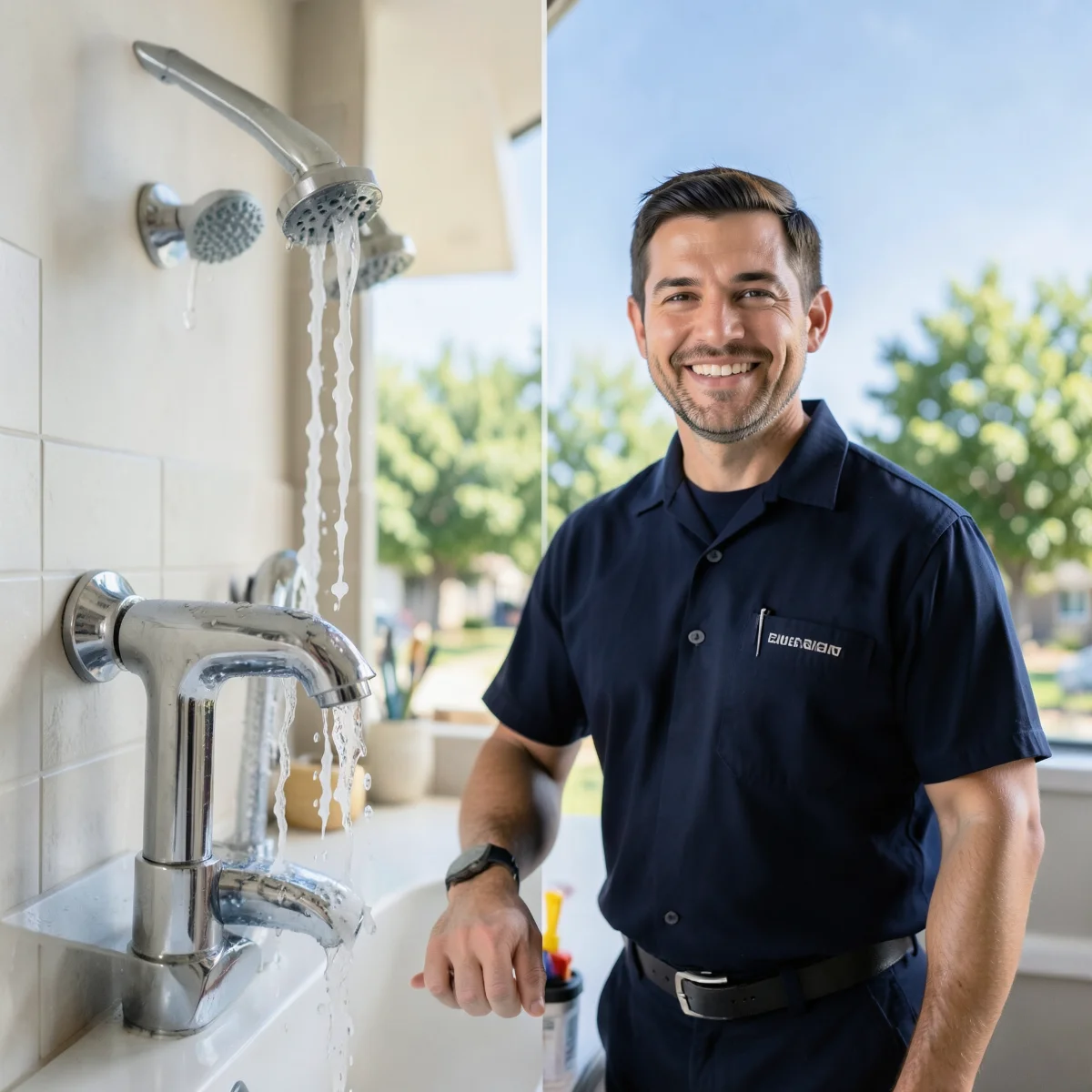
Arvada and the broader Front Range consistently measure among the harder water sources in the metro area. Depending on your service zone and seasonal variation, hardness can run 15–25 grains per gallon (GPG) — water that is classified as very hard and that produces visible effects on fixtures, appliances, and skin within months of exposure. Most homeowners know something is off long before they know what to call it.
The water softener pitch sounds simple: install a system, and the scale stops. The reality is more nuanced — there are different technologies, meaningful trade-offs, and a cost structure that makes sense for some households and not others. This post gives you the honest breakdown.
What hard water is actually doing in your home
Hard water is water with high concentrations of dissolved calcium and magnesium. These minerals are harmless to drink at normal concentrations, but they precipitate out of solution as scale when water is heated or sits on surfaces. The scale is the white crust on your faucets, the deposits inside your water heater, the film on shower glass, and — invisibly — the mineral buildup narrowing your supply lines over years.
The most financially significant effect is on water heaters. Scale settling at the bottom of a tank heater insulates the burner from the water. The burner runs longer and hotter, the lining stresses earlier, and the unit fails years before it should. Tankless units are not spared — scale on heat exchanger coils reduces efficiency and triggers error codes. In Arvada's hard-water range, this shortens appliance life in measurable ways.
For homes near Golden and the foothills corridor, water hardness can push toward the higher end of the regional range due to the calcite-heavy geology of the mountains contributing to the source water. If you are in that zone, the case for treatment is even stronger.
How salt-based ion exchange softeners work
A conventional ion-exchange water softener passes water through a resin tank filled with charged resin beads. The beads attract and hold calcium and magnesium ions, releasing sodium ions in exchange. The result is softened water — essentially free of hardness minerals — flowing through your home. The resin bed eventually saturates and is recharged automatically by a brine flush on a set schedule.
This is the technology with the strongest evidence base for protecting plumbing and appliances. It removes hardness completely, not partially. It works at Arvada's hardness levels where softer approaches are less effective.
The trade-offs: the system requires salt to be added to the brine tank every 4–8 weeks depending on water use and hardness. Softened water adds a small amount of sodium — roughly 30–50 mg per 8 oz glass at Arvada's hardness levels — which is below what most people can taste but matters to households on sodium-restricted diets. A reverse-osmosis filter at the kitchen tap removes the sodium from drinking water if desired.
Salt-free conditioners: what they do and what they do not do
Template Assisted Crystallization (TAC) systems — marketed under various brand names as salt-free conditioners — change the form of hardness minerals rather than removing them. The calcium and magnesium stay in the water but convert to a crystalline form that does not adhere to surfaces as strongly. Scale is reduced; it is not eliminated.
For Arvada homes at 15–25 GPG hardness, TAC systems offer partial protection. They are most effective at reducing scale formation on heat exchanger surfaces and pipes. They require no salt or electricity. These are genuine advantages for households that object to the ongoing cost of salt or the sodium addition.
The honest limitation: at high hardness levels, salt-free conditioners do not protect appliances as effectively as ion-exchange softeners. If your primary motivation is extending water heater and appliance life in a high-hardness zone, a salt-based system gives you more measurable protection.
Pairing with whole-home water filtration
A water softener addresses hardness. A whole-home water filtration system addresses a broader set of water quality concerns — sediment, chlorine, chloramines, and in some cases specific contaminants depending on your source water. They are different tools and solve different problems.
For many Arvada households, the most complete solution is a softener for hardness protection combined with a carbon filtration system for taste and odor. The softener protects the infrastructure; the filter improves what comes out of the kitchen tap. These are often installed together at the point of entry and sized to work as a system.
The cost for a combined softener and carbon filter installation in Arvada runs broadly in the range of $1,500–$3,500 depending on flow rate sizing, brand, and whether existing infrastructure needs modification. This is general guidance — an on-site assessment is the only way to produce an accurate figure for your specific home. Call today for service availability and upfront estimate options.
- Ion-exchange softener: removes hardness completely; requires salt; adds trace sodium; strongest appliance protection
- Salt-free conditioner: reduces scale formation; no salt or sodium; simpler maintenance; less effective at very high hardness
- Carbon filtration: improves taste and odor; removes chlorine and chloramines; does not soften water
- Combined softener plus filter: most complete solution for hardness and water quality together
- Reverse osmosis at kitchen tap only: removes sodium from softened water and nearly all dissolved solids; for drinking water only
Key takeaways
- Arvada's 15–25 GPG water hardness is enough to measurably shorten water heater life and clog aerators — the problem is real and quantifiable.
- Salt-based ion-exchange softeners are the most effective solution for complete hardness removal and appliance protection at Arvada's hardness levels.
- Salt-free conditioners reduce scale formation without salt or sodium but are less effective than ion exchange at very high hardness.
- Pairing a softener with carbon filtration addresses both hardness and water quality — the most complete whole-home solution.
- Get a water test before purchasing any system — knowing your actual hardness GPG prevents over- or under-sizing the treatment.
Frequently asked questions
A typical residential ion-exchange softener uses 30–50 pounds of salt per month for an average household of 3–4 people at Arvada's hardness levels. Demand-initiated regeneration systems regenerate only when needed, which can reduce salt consumption by 20–30% compared to older timer-based systems.
Softened water is not ideal for irrigation — the sodium can gradually affect soil structure and some plant species over time. Most softener installations include a bypass for outdoor hose bibs so you can water plants with unsoftened water. This is a standard configuration to request at installation.
Water softener installation does not typically require a permit in Arvada for a straight point-of-entry connection. If significant plumbing modifications are required — new drain line routing, main line work — that may change. Your installer should confirm permit requirements at the time of the estimate.
Local plumbing help mentioned in this article
Service areas
Need a hand from a local Arvada plumber?
Whether it is an emergency or a project you have been putting off, Arvada Pro Plumbing dispatches locally, 24/7, with upfront pricing. Call now or request service online.