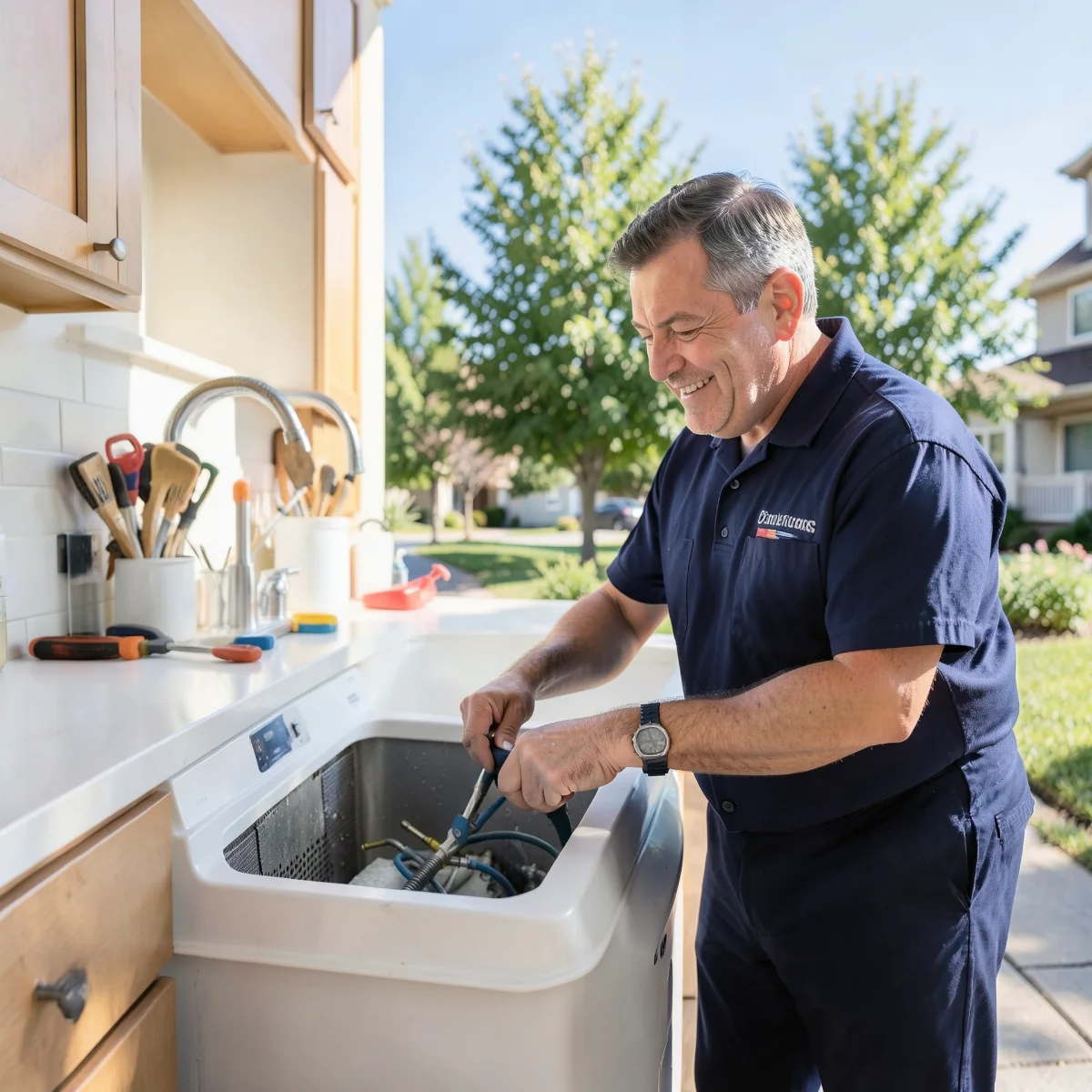
Garbage disposals fail in a handful of predictable ways, and most homeowners have no idea which failure they are dealing with. A disposal that hums but does not spin is a jammed unit — the motor is running and hitting a locked rotor. A disposal that does nothing at all is probably tripped, not dead. A disposal that leaks is a seal or connection issue. Each has a different fix.
In Arvada's hard-water environment, mineral deposits and food debris combine to accelerate wear on disposal components. Knowing what you are dealing with before you call — or before you reach under the sink with tools — is both safer and cheaper.
The disposal hums but does not grind
Humming without grinding means the motor is receiving power and trying to run, but the grinding plate is stuck. This is a jam — the most common disposal complaint. Something hard (a bone chip, a pit, a small utensil) has wedged between the impeller and the grinding ring.
First, cut power at the switch. Do not put your hand in the drain. Insert the hex wrench (usually 1/4-inch) that came with the unit — or a standard Allen wrench — into the socket at the bottom center of the disposal. Work it back and forth until you feel the plate break free. Then use disposal tongs or needle-nose pliers — never your fingers — to fish out whatever caused the jam. Restore power, press the reset button on the bottom of the unit, and test.
If the unit jams repeatedly on the same kind of food, the problem is habit, not the disposal. Fibrous materials like celery and artichoke, starchy foods like pasta and rice, and hard items like peach pits and shellfish are all disposal killers regardless of what the packaging claims. In Wheat Ridge and older Arvada kitchens, disposals that are already working harder against hard-water scale tolerate abuse even less.
The disposal does nothing at all
Total silence when you flip the switch is almost always a tripped thermal overload, not a dead motor. The reset button is a small red or black button on the bottom of the unit. If it has popped out, press it firmly until you feel it click. Then try the disposal again.
If pressing reset does not help, check the circuit breaker. Disposals pull a surprising amount of current at startup, especially older or undersized units. A tripped breaker on a kitchen circuit is worth checking before assuming the disposal has failed.
If the breaker is fine, the reset button stays in, and the unit is still completely unresponsive, you likely have a failed motor or a failed switch. At this point it is worth a pro diagnosis: kitchen plumbing and disposal service can confirm whether you are looking at a straightforward switch replacement or a disposal that has simply reached the end of its useful life. Disposals typically last 8–12 years; hard water and heavy use push that to the lower end.
The disposal leaks
Disposal leaks come from three places, and the location tells you the fix. A leak from the top — around the flange where the disposal meets the sink drain — usually means the plumber's putty under the flange has dried and shrunk, or the mounting ring has loosened. Remounting and resealing the flange is a straightforward repair.
A leak from the side of the disposal body, where the dishwasher drain hose connects, points to a failed gasket at that fitting. Replace the gasket and retighten the clamp. A leak from the bottom of the disposal body itself — from the reset button area or from a seam in the housing — is a failed internal seal, and this typically means the unit needs replacement, not repair.
For garbage disposal repair that involves remounting or dishwasher connections, most homeowners can handle it with a few common tools and a plumber's putty tube. For a leak from the body, the repair cost rarely makes sense versus a new unit installation.
What disposals cannot handle — and what to do instead
The list of things that reliably jam or damage disposals is longer than most people realize. Beyond the obvious ones — glass, metal, bones — the everyday culprits are starchy foods (potato peels, pasta, rice), fibrous produce (celery, artichoke, onion skins), and coffee grounds in volume. Expandable, fibrous, or hard items are disposal enemies regardless of the horsepower rating on the unit.
Grease is a drain-line problem, not a disposal problem. Liquid grease flushes through the disposal fine — then cools and solidifies further down the line, building up alongside hard-water scale in the drain. Over months, that combination creates a narrowed line that eventually backs up. Dispose of cooking grease in a container, not the drain.
- Fibrous vegetables: celery, artichoke leaves, corn husks, onion skins
- Starchy foods: potato peels, pasta, rice, bread
- Hard items: fruit pits, bones, shellfish shells, olive pits
- Grease, fats, and cooking oil — drain into a can, not the disposal
- Coffee grounds in large quantities — they accumulate in drain bends
- Non-food items of any kind
When to replace instead of repair
A disposal under 5 years old that jams repeatedly or has a single component failure — switch, reset button, or side connection — is usually worth repairing. Labor plus parts typically runs less than a new installed unit in those scenarios.
A disposal that is 8–12 years old, has a body leak, has required multiple repairs, or simply runs louder and less effectively than it used to is a replacement candidate. Modern disposals in the 3/4 to 1 HP range are meaningfully quieter and more capable than units from the mid-2010s. If you are remodeling your kitchen or having kitchen plumbing work done anyway, bundling a disposal replacement into that visit is the most cost-effective timing. Call (207) 419-2600 for availability and upfront estimate options.
Key takeaways
- A humming disposal is jammed — use the hex wrench at the bottom to free the plate before calling anyone.
- A completely silent disposal is usually tripped — press the reset button on the bottom of the unit first.
- Leaks from the disposal body itself mean replacement; leaks from the flange or fittings are repairable.
- Fibrous, starchy, and hard foods are the leading causes of disposal jams regardless of unit horsepower.
- Disposals 8–12 years old with body leaks or repeated failures are replacement candidates, not repair candidates.
Frequently asked questions
If the unit has been jamming and resetting without your intervention, something is cycling through the grind zone repeatedly. Identify and remove whatever is causing the jam before running the disposal again — continued jamming stresses the motor and accelerates wear.
For most Arvada households, a 1/2 HP or 3/4 HP unit handles everyday use. If you cook frequently and grind more than light vegetable prep and plate scrapings, 3/4 to 1 HP gives you more margin. Larger motors also tend to run quieter. Match the mounting system to your existing sink drain flange if possible — it simplifies the swap.
Most residential disposals carry manufacturer warranties of 2–5 years on parts. Some premium units carry 10-year warranties. Keep your purchase receipt and registration; warranty claims require proof of purchase and usually exclude installation labor.
Local plumbing help mentioned in this article
Service areas
Need a hand from a local Arvada plumber?
Whether it is an emergency or a project you have been putting off, Arvada Pro Plumbing dispatches locally, 24/7, with upfront pricing. Call now or request service online.